

The 30-second version
Two of the four current UK write-off categories cover cars that can return to the road. Cat N is the lighter one. It applies to non-structural damage: bumpers, panels, doors, lights, interior. The chassis and structural frame are intact.
Cat S is the heavier one. It applies to damage that needed repair, realignment, or replacement of the structural frame or chassis. That covers the firewall, chassis legs, pillar reinforcements, inner sills, and (under V12) the front and rear mega-castings on newer EVs.
The category isn’t about repair cost. It’s about damage type. An Appropriately Qualified Person assessing the car checks the damage against the V12 structural list. If any listed component needs work, the car is Cat S. If not, it’s Cat N.
That’s the only line that separates them. Everything else (resale discount, premium uplift, MOT requirement, V5C treatment, repair standards, safety implications) follows from that one decision.
Cat N vs Cat S: full comparison table
| Dimension | Cat N | Cat S |
|---|---|---|
| Damage type | Repairable, non-structural | Repairable, structural |
| V12 reference | Illustration 3 (15 non-structural components) | Illustration 2 (20 structural components) |
| Who decides | AQP (Appropriately Qualified Person) | AQP (Appropriately Qualified Person) |
| Can it return to the road? | Yes, once repaired roadworthy | Yes, once professionally repaired |
| New MOT typically required? | No, existing MOT stays valid | Yes, after repair |
| V5C log book | Original V5C retained, no comment | Re-issued via form V62, literal comment recording Cat S |
| Repair standards | No mandated method; quality is the buyer’s concern | Manufacturer-approved or Thatcham-recognised; original structural components only |
| Buy-back permitted? | Yes | Yes |
| Resale discount (industry estimate) | 20-40% below clean | 30-50% below clean |
| Premium uplift (industry estimate) | 20-50% over clean | 30-80% over clean |
| Mainstream insurer availability | Most UK insurers cover | Some decline entirely; specialist often cheapest |
| Forensic inspection (typical) | £100-£300 | £300-£500+ |
| Marker permanence | Permanent on VS&TD register | Permanent on VS&TD register |
| Safety implications | Limited; cosmetic and component damage only | Material; affects crash performance and ADAS calibration |
| Replaced (and when) | Cat D, on 1 October 2017 | Cat C, on 1 October 2017 |
Source: ABI Code of Practice V12, May 2025; GOV.UK insurance write-offs guidance; industry market data for resale and premium estimates.
The single difference that matters
The whole distinction reduces to one question: did the damage touch a component on the V12 structural list?
V12 lists 20 structural components in Illustration 2: firewall, front and rear chassis legs, pillar reinforcements, inner sills, the welded chassis frame, the roof side cant rail, and (new in V12) the front and rear one-piece mega-castings used on Tesla and a growing number of EV competitors. Repair, realignment, or replacement of any of those triggers Cat S.
V12 also lists 15 non-structural components in Illustration 3: bumpers and bumper reinforcements, bonnet, front wing, door skins and assemblies, slam panel, roof panel, rear quarter panel, boot lid, and similar. Damage confined to these is Cat N.
The AQP checks whether non-structural damage has pushed back into structural elements behind the outer skin. If it has, the car is Cat S, not Cat N. A bumper hit that bent the chassis leg behind it is Cat S, even though the visible damage is to the bumper.
That’s the line. Repair cost doesn’t move it. Severity of visible damage doesn’t move it. Structural component involvement is the whole rule.
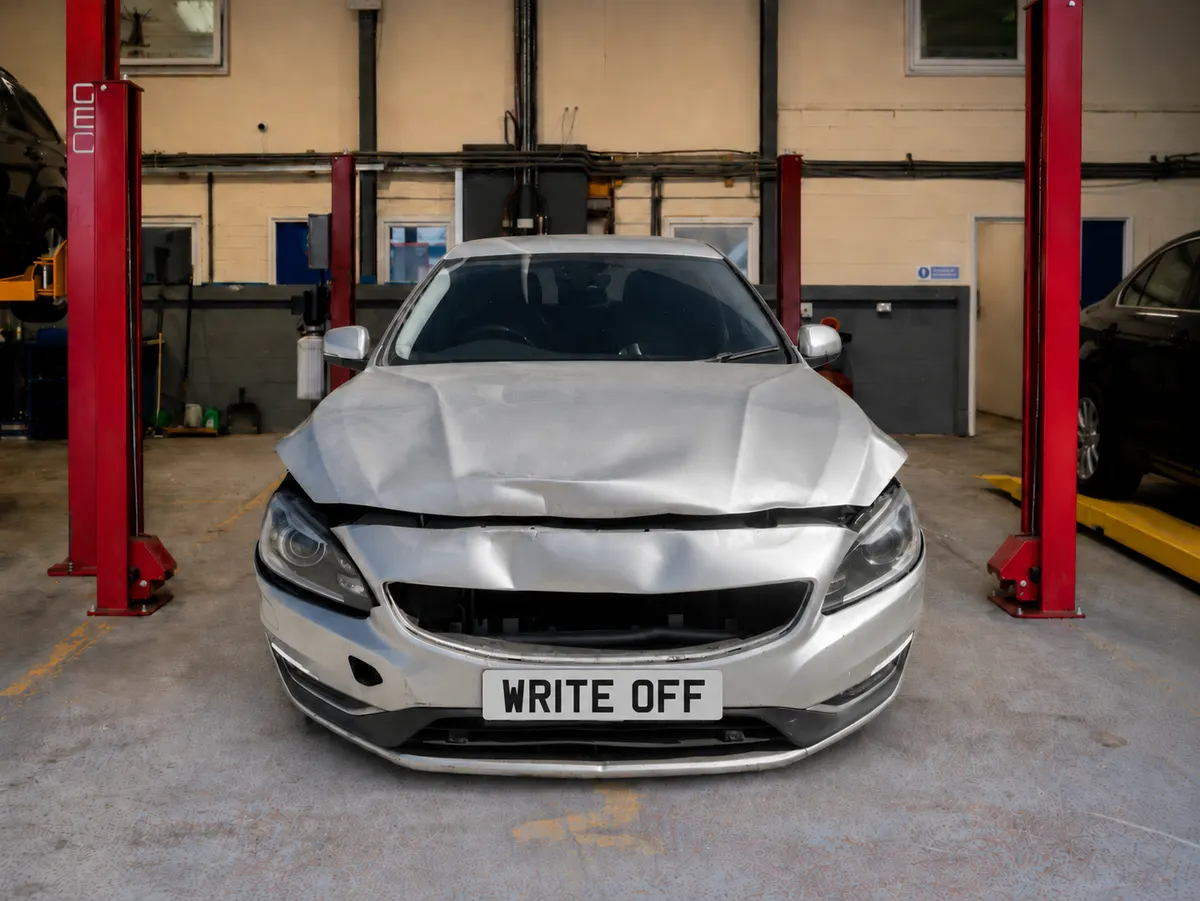
It’s a common confusion. A car that looks shockingly bashed up but only on cosmetic panels can stay Cat N. A car that looks barely touched but has bent a chassis leg becomes Cat S. Visible damage is a poor guide to the category.
Which one is worse?
Cat S is generally worse, on four measures:
- Resale discount runs deeper: industry estimates suggest 30-50% for Cat S versus 20-40% for Cat N
- Premium uplift is bigger: industry estimates suggest 30-80% for Cat S versus 20-50% for Cat N
- Some mainstream UK insurers decline Cat S entirely on commercial-risk grounds; most cover Cat N
- A new MOT is typically required after Cat S repair; the existing MOT remains valid for Cat N
The safety dimension matters too. Structural repairs determine how a car will perform in a future crash. Crumple zones deform in specific designed ways, and airbags rely on the car’s structural geometry to fire at the right moment and angle. ADAS calibration (lane keeping, autonomous emergency braking, adaptive cruise) depends on sensor positions tied to the vehicle structure, and that calibration has to be re-done after structural repair. A bad Cat S repair has consequences a bad Cat N repair does not.
Cat N isn’t trivial. Repair quality still matters. A badly-repaired Cat N car can have mismatched paint, uneven panel gaps, and hidden corrosion. The difference is that the crash structure is intact, so the failure modes are bodywork failures, not safety failures.
When each applies (five worked scenarios)
Scenario 1: Front bumper crash, bonnet bent, headlights cracked. Damage is limited to the bumper, bumper reinforcement, bonnet, and lighting. None of those components are on the V12 structural list. The firewall and chassis legs behind the bonnet are untouched. Outcome: Cat N.
Scenario 2: Rear-end shunt, rear chassis leg bent. The rear chassis leg is item 17 on the V12 structural list. Repair needs realignment to original dimensions. Outcome: Cat S.
Scenario 3: Side impact, dented door, no intrusion behind the skin. Damage is limited to the door skin and door assembly. The inner sill and B-post reinforcement behind the door are intact. Outcome: Cat N.
Scenario 4: Side impact, dented door, B-post reinforcement deformed. Damage starts at the door but extends into the inner B-post pillar reinforcement, which is item 9 on the V12 structural list. Outcome: Cat S.
Scenario 5: Tesla Model Y rear impact, rear mega-casting damaged. The rear one-piece mega-casting is item 16 on the V12 structural list (new in V12, May 2025). Damage that needs repair or replacement of the cast component triggers structural categorisation. Outcome: Cat S.
The common thread: the V12 structural list is the rule. If the AQP determines any listed component needs repair, realignment, or replacement, the car is Cat S regardless of the visible damage pattern. For the full structural and non-structural lists, see What is Cat S? and What is Cat N?.
Insurance: Cat N vs Cat S
Q: If I already have insurance and the car becomes Cat N or Cat S, what happens to my cover?
A: The original policy ends when the insurer settles the claim. If you buy back the salvage, or if a different keeper later buys the repaired car, fresh cover has to be arranged. The new insurer prices Cat N or Cat S based on the marker showing on the VS&TD register, not on whether cover was held when the accident happened.
On price, industry estimates suggest Cat N attracts a premium uplift of around 20-50%, and Cat S around 30-80%. Specialist insurers and brokers placing categorised business are often more competitive than mainstream insurers on either category.
On availability, the practical difference is bigger than the headline numbers. Most mainstream UK insurers cover Cat N. Some major insurers decline Cat S entirely on commercial-risk grounds, which means the pool of options is smaller and a specialist quote is more likely to be the cheapest.
On disclosure, the rule is identical for both. You must answer truthfully if asked about write-off history at quote stage. Failure to disclose when asked is misrepresentation under the Consumer Insurance (Disclosure and Representations) Act 2012 and can void cover.
Resale: Cat N vs Cat S
Industry estimates suggest a Cat N car typically sells for 20-40% less than a clean-title equivalent, and a Cat S car typically sells for 30-50% less. The same factors widen or close the discount on both: make and model, repair quality, documentation pack, mileage and age, and whether the buyer is private or trade.
The factor that matters more on Cat S is the documentation pack. A Cat N buyer is mainly concerned with repair quality. A Cat S buyer is concerned with repair quality plus structural integrity plus ADAS calibration plus a fresh MOT. A Cat S car with a full engineer’s report, body shop letter confirming Thatcham methodology, and ADAS calibration records closes the discount meaningfully. The same car without those documents sits at the bottom of the range or worse.
Working example. A £15,000 clean-title equivalent might fetch £9,000-£12,000 as Cat N. A £20,000 clean-title equivalent might fetch £10,000-£14,000 as Cat S. The wider range on Cat S reflects how much documentation moves the needle.
The discount applies every time the car is sold, not just at the first resale.
Buying: which is the safer purchase?
For most private buyers, Cat N is the safer purchase of the two. The damage is non-structural, the chassis is intact, the existing MOT remains valid, mainstream insurance is available, and a forensic inspection costs £100-£300 rather than £300-£500 or more.
Cat S can still be a sensible purchase if three things line up. The price discount is substantial (toward the lower end of the 30-50% range or below). The repair documentation is complete: engineer’s report, body shop letter confirming methodology, ADAS calibration records where applicable, and a fresh MOT. And insurance availability and price for the specific vehicle have been confirmed before purchase.
The verification process is similar for both: run a vehicle history check (HPI Check or Experian AutoCheck), inspect the V5C in person, request the engineer’s report, and commission a forensic inspection. The differences: a Cat S V5C carries a literal comment recording the status; a Cat N V5C does not. Forensic inspection cost is meaningfully higher on Cat S.
For deeper decision frameworks, see Should I buy a Cat N car? and Should I buy a Cat S car?.
Selling: which is harder to move on?
Cat S is harder to sell. The buyer pool is smaller, documentation expectations are higher, and a missing engineer’s report or body shop letter widens the discount more aggressively than on Cat N.
Cat N sells more easily on the open market. Many trade and private buyers will look at a Cat N car with the same lens as a clean car at a discount. Cat S triggers more caution, more questions, and more pre-purchase inspections.
For both, the documentation pack is the biggest variable: re-issued V5C (Cat S only), engineer’s report, original damage assessment, repair invoices, body shop methodology letter, repair photographs where available, fresh MOT, and ADAS calibration records where applicable. Cat S adds HV battery assessment for EVs.
Honest presentation matters on both. Hiding a Cat N or Cat S marker doesn’t work (buyers run history checks) and exposes private sellers to misrepresentation claims and trade sellers to Consumer Rights Act issues.
The legacy question: Cat C and Cat D
The current S/N split replaced the older C/D split on 1 October 2017 under ABI Code V10. Cars categorised before that date keep their original marker:
- Cat C markers from before October 2017 are permanent and do not convert to Cat S
- Cat D markers from before October 2017 are permanent and do not convert to Cat N
The market treats Cat C similarly to Cat S, and Cat D similarly to Cat N. The technical difference is in how the assessment was made under the older Code (Cat C and Cat D were based on repair cost relative to value), but the practical consequences for owners are broadly the same. For buying decisions, treat Cat C as Cat S, and Cat D as Cat N.
FAQ
What's the difference between Cat N and Cat S?
Cat N covers repairable non-structural damage (bumpers, panels, doors, lights, interior). Cat S covers repairable structural damage (frame, chassis, pillar reinforcements, inner sills, mega-castings on newer EVs). The Appropriately Qualified Person assigns the category based on the V12 structural list, not on repair cost.
Is Cat S worse than Cat N?
Generally yes. Industry estimates suggest Cat S carries a 30-50% resale discount versus 20-40% for Cat N, and a 30-80% premium uplift versus 20-50%. Some mainstream insurers decline Cat S entirely. The safety implications of structural damage also make repair quality and documentation more important on Cat S.
Can both Cat N and Cat S cars be driven legally?
Yes, once professionally repaired. Cat S typically requires a new MOT after repair and a re-issued V5C with a literal comment (applied for via form V62). Cat N keeps its existing MOT and original V5C; the marker is held on DVLA systems rather than the log book itself.
Does a Cat N car need a new MOT? Does a Cat S?
Cat N does not; the existing MOT remains valid. Cat S typically does, because structural repair means the existing certificate is no longer considered sufficient evidence of roadworthiness. A fresh MOT is standard practice after Cat S repair.
Which is harder to insure, Cat N or Cat S?
Cat S. Most mainstream UK insurers cover Cat N at a moderate premium uplift. Some major insurers decline Cat S entirely on commercial-risk grounds, which makes the available pool smaller and a specialist quote more likely to be the cheapest.
Which discounts more on resale, Cat N or Cat S?
Cat S. Industry estimates suggest a Cat S car typically sells for 30-50% less than a clean-title equivalent. Cat N typically sells at 20-40% less. The discount on Cat S depends heavily on the quality of repair documentation; a missing engineer's report or methodology letter widens it.
Who decides whether a car is Cat N or Cat S?
An Appropriately Qualified Person (AQP) working for the insurer. They check the damage against the V12 structural list in Illustration 2. If repair is needed to any of the 20 structural components, the car is Cat S. If not, it is Cat N. The decision is final unless formally disputed.
Can a Cat N car become Cat S after further damage?
In effect, yes. If a Cat N car is later involved in another accident and the new damage extends to a structural component, the AQP assessing the new claim can categorise it as Cat S. The Cat N marker stays on the VS&TD register and the Cat S marker is added; both remain visible on history checks.
Can I buy back my own car if it's been categorised?
Yes, for both Cat N and Cat S. Buy-back is not permitted on Cat A or Cat B. The insurer pays a reduced settlement to reflect the salvage value. For Cat S, the V5C must be re-issued via form V62 with the literal comment. For Cat N, the original V5C stays in place.
What's the difference between Cat N and Cat D, or Cat S and Cat C?
Cat D and Cat C were retired on 1 October 2017 when the current S/N split came in. Cat D was the predecessor to Cat N (lighter damage); Cat C was the predecessor to Cat S (heavier damage). The technical difference is in assessment basis (cost-led vs damage-type), but the market treats them similarly.
Is the ABI Salvage Code law?
No. It is a voluntary industry code, not statute. The Association of British Insurers maintains it. Around 97% of UK motor insurers (every ABI member) adhere to it. The government confirmed in February 2026 it has no plans to give the Code statutory footing.
What happens to the V5C on a Cat N versus a Cat S?
For Cat N, the original V5C stays in place; DVLA records the marker on its system. For Cat S, the V5C is re-issued with a literal comment recording the status. The new keeper applies via form V62, which is free.