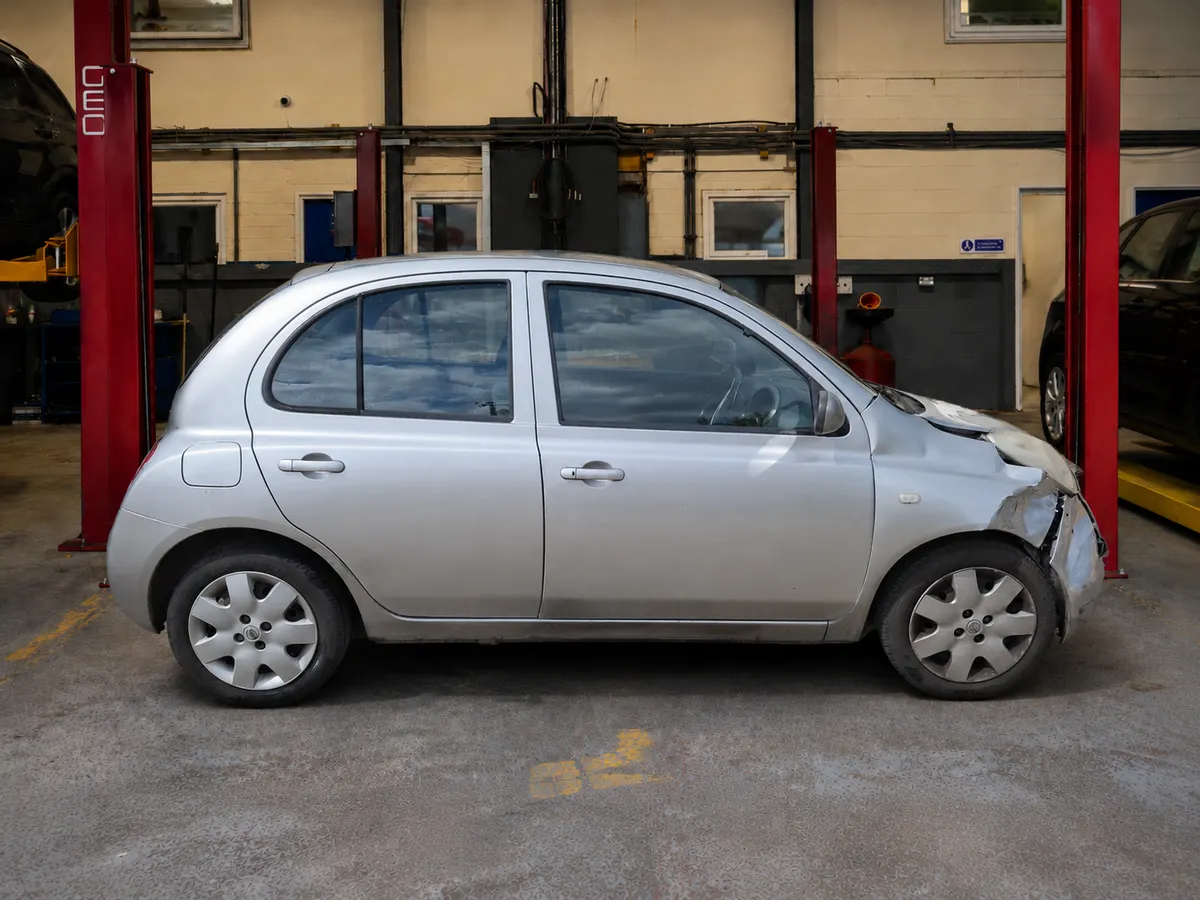



What “Cat N” actually means
Cat N stands for Category N. The N is for “non-structural.” A Cat N car is one your insurer has written off after a claim where the damage was limited to non-structural components. Bumpers, bonnet, doors, wings, panels, lights, electrics, interior. The structural frame and chassis are intact.
It’s the lightest of the four current write-off categories. Cat N cars can return to the road once repaired to a roadworthy condition. The existing MOT remains valid. You don’t need a new V5C; the original log book stays in place, with the Cat N marker recorded against the vehicle by DVLA.
Cat N was introduced on 1 October 2017, replacing the older Cat D under the ABI Code of Practice for the Categorisation of Motorised Vehicle Salvage. The current version of that Code is V12, published 28 May 2025.
The Cat N marker is permanent. It cannot be removed by a good repair, a fresh MOT, or the passage of time. Once a car is on the Vehicle Salvage & Theft Data register (VS&TD, formerly MIAFTR) with a Cat N marker, it remains part of the vehicle’s permanent history.
For a wider overview of UK write-off categories, see our pillar guide to insurance write-offs.
Quick check: is this car actually Cat N?
Three quick checks if you’re researching a specific car:
- Run a vehicle history check. HPI Check or Experian AutoCheck will show the Cat N marker if it’s on the VS&TD register.
- Look at the V5C log book. Cat N markers are recorded by DVLA against the vehicle, though the document itself is the original (unlike Cat S, which gets a re-issued V5C with a literal comment).
- Ask the seller directly. A trade seller is legally obliged to disclose under the Consumer Rights Act 2015. A private seller has less obligation, but a refusal to confirm is itself a flag.
If the history check returns a clean record but the price looks low or the seller is evasive, get an independent inspection. The history check is necessary but not always sufficient. Some write-offs slip through. See How to check if a car is Cat N below.
The official Cat N definition (ABI Code V12)
The ABI Code V12 defines Cat N as:
A repairable vehicle which has not sustained damage to the structural framework or chassis. The vehicle may still have safety-critical items requiring replacement (for example, airbags or seat belts), but the underlying structure is intact.
Three things follow from that definition:
- The damage is non-structural by design. If repair work touches any structural component on the V12 list (see next section), the car becomes Cat S, not Cat N.
- Safety-critical replacements are still allowed. Airbags, seat belts, seat belt pretensioners. These can need replacing on a Cat N car. The structure under them is still sound.
- The vehicle can return to the road. Unlike Cat A or Cat B, a Cat N car is not destined for destruction. Once it’s roadworthy, it’s roadworthy.
Non-structural damage: the V12 list
The ABI Code V12 lists the components that count as non-structural. If damage is limited to any of these (and only these), the vehicle is Cat N. The list is from Illustration 3 of the Code.
Front of vehicle:
- Front bumper
- Front bumper reinforcement (and reinforcement assembly)
- Bonnet
- Front wing
- Slam panel
- Apron filler panel
Sides and doors:
- Door skin
- Door assembly
- Rear quarter panel
Roof:
- Roof panel
Rear of vehicle:
- Rear panel outer
- Rear bumper
- Rear bumper reinforcement
- Boot lid / tailgate
- Boot floor
- Load bed assembly (pickups and similar)
A car can take damage to any combination of those components and still be Cat N, provided the damage doesn’t extend behind the outer skin into the structural elements. Things like the firewall, chassis legs, inner sills, B-post reinforcements, and so on.
The AQP, the Appropriately Qualified Person assessing the car, is required to check for that intrusion. If non-structural damage has pushed back into a structural component, the car becomes Cat S.
This is the line that determines whether you’re dealing with Cat N or Cat S, and it matters. The resale and insurance implications are meaningfully different.
Cat N vs Cat S vs Cat A vs Cat B
| Category | Damage type | Back on the road? | V5C re-issued | Buy-back allowed? | Replaced |
|---|---|---|---|---|---|
| Cat N | Repairable non-structural | Yes, after repair | Yes, no comment | Yes | Cat D (2017) |
| Cat S | Repairable structural | Yes, after repair | Yes, with literal comment | Yes | Cat C (2017) |
| Cat A | Scrap, no usable parts | No | No (destroyed) | No | — |
| Cat B | Shell unrepairable, parts salvageable | No (whole vehicle) | No (destroyed) | No | — |
Source: GOV.UK insurance write-offs guidance; ABI Code of Practice V12, May 2025.
For a detailed side-by-side, see Cat N vs Cat S: the key differences.
How Cat N is decided
A car ends up Cat N through a fairly standard sequence:
- Claim is submitted. You report the accident to your insurer with damage photos, the V5C, and the accident report.
- Engineer inspection. The insurer arranges for an AQP to inspect the car, usually through a salvage yard partner. The inspection covers the damage type, extent, and likely repair cost.
- Category assigned. The AQP applies the V12 rules. If damage is non-structural only, the car is Cat N. If damage is structural, it’s Cat S. If it’s unrepairable, it’s Cat A or Cat B.
- Pre-accident market value calculated. The insurer uses industry valuation tools (Glass’s Guide, CAP Black Book) plus live market data to value the car.
- Settlement offer made. The insurer offers you the pre-accident market value minus your excess and any outstanding finance.
- VS&TD record created. Within two working days of the final categorisation decision, the insurer enters the vehicle on the Vehicle Salvage & Theft Data register (formerly MIAFTR, renamed on 24 November 2025). This record is permanent.
- DVLA notified. You notify DVLA via gov.uk/written-off-vehicle. Failing to notify carries a £1,000 fine.
The whole process typically takes two to four weeks from claim to settlement.
The category is not based on repair cost alone. It’s based on damage type. A £400 dented bumper can put a £2,000 car into Cat N because the repair cost exceeds the value, even though the damage itself is trivial. That’s the most common cause of Cat N markers on older cars.
Can you drive a Cat N car?
Yes, once it has been repaired to a roadworthy condition.
The specifics:
- The existing MOT remains valid. Unlike Cat S, a Cat N car does not automatically need a new MOT after repair. The current certificate stays in force until its normal expiry.
- No new V5C is needed. The original log book remains valid. DVLA records the Cat N marker against the vehicle on its system; the V5C itself is not re-issued with a literal comment (which is the Cat S treatment).
- Roadworthiness is your responsibility. The car must meet the same legal standards as any other vehicle. Working lights, sound brakes, tyres within legal limits, no excessive corrosion, all safety-critical components functioning. If you’ve bought a Cat N car that hasn’t been repaired yet, you’ll need to put it into roadworthy condition before driving it on public roads.
- Repairs should be done properly. While there’s no legal requirement to use manufacturer-approved methods on non-structural damage (that requirement applies to Cat S structural work), poor repair quality is the biggest issue with badly-bought Cat N cars. Mismatched paint, uneven panel gaps, and amateur welding are common signs of a Cat N that’s been done cheaply.
Insurance impact
A Cat N marker affects insurance in three ways: premium, choice of insurer, and disclosure obligations.
Premium
Industry estimates suggest a Cat N car attracts a premium uplift of around 20-50% compared to a clean-title equivalent. The exact figure depends on the insurer, the car, your driving history, and the quality of repair documentation you can supply. Some insurers price Cat N similarly to a clean car, particularly if you’re staying with the same insurer who originally settled the write-off. Others apply a more significant uplift.
Choice of insurer
Most mainstream UK insurers will cover Cat N cars. This is in contrast to Cat S, where some major insurers decline cover entirely and you may need a specialist. Cat N is the easier of the two repairable categories to insure.
That said, you’ll generally get better rates from insurers who deal with categorised vehicles regularly. Specialist insurers (and brokers who place categorised business) often quote more competitively on Cat N than mainstream insurers who treat it as a higher-risk edge case.
Disclosure
When you take out an insurance policy on a Cat N car, the insurer will ask about the vehicle’s write-off history at quote stage. You must answer honestly. Failure to disclose when asked is misrepresentation under the Consumer Insurance (Disclosure and Representations) Act 2012 and can void your cover.
The duty bites when you’re asked, not before. You’re not legally required to volunteer the information unprompted. But every motor insurer will ask, and the answer has to be truthful.
Resale impact
Industry estimates suggest a Cat N car typically sells for around 20-40% less than a clean-title equivalent. The actual discount varies significantly based on:
- Make and model. Cars in high demand hold their value better even with a Cat N marker. Older, lower-demand cars take bigger discounts.
- Repair quality. A well-documented repair with photos, invoices, and a body shop letter confirming methodology will close the discount. A repair with no paperwork widens it.
- Mileage and age. Older, higher-mileage cars take a larger proportionate hit because the marker compounds with existing depreciation factors.
- Buyer pool. Private buyers tend to discount more heavily than trade buyers, who are more comfortable with categorised cars.
A working example: a £15,000 clean-title equivalent might sell at around £9,000 to £12,000 as Cat N, depending on the factors above. The lower end of that range is more likely on private listings without strong documentation; the upper end is more achievable with a full repair paper trail and a trade-friendly buyer.
The resale discount is not a one-time hit. It applies every time the car is sold, for as long as it’s on the road. A Cat N car sold three times over its lifetime takes the discount three times.
How to check if a car is Cat N (procedure)
The most reliable way to check whether a specific car is Cat N is to run a vehicle history check and combine it with a physical inspection.
Step 1: Run a vehicle history check. Use HPI Check, Experian AutoCheck, or any reputable reseller. Costs typically range from £4.99 to £19.99. The check will show the Cat N marker if the vehicle is on the VS&TD register (formerly MIAFTR). It will also flag stolen vehicle indicators, outstanding finance, mileage discrepancy, and previous keepers.
Step 2: Cross-check with DVLA records. The free DVLA vehicle enquiry service at gov.uk/get-vehicle-information-from-dvla confirms tax and MOT status. While it doesn’t show the Cat marker directly, it gives you a baseline to compare against the seller’s claims.
Step 3: Inspect the V5C in person. Check the V5C log book. For Cat N, the document itself remains the original; there’s no literal comment added (that’s the Cat S treatment). What you’re checking for is consistency: the VIN on the V5C should match the VIN on the car, the registered keeper history should match the seller’s claims, and the V5C should not be a recent replacement without explanation.
Step 4: Physically inspect the car. Look for the common signs of past repair work. Mismatched paint shades between panels. “Orange peel” paint texture. Uneven panel gaps. Evidence of amateur welding in the engine bay. Replacement bumpers with slight colour variation. Drive the car if possible. Pulling to one side, unusual tyre wear patterns, and inconsistent steering feel can indicate poor repair work.
Step 5: Ask the seller for documentation. A seller who’s confident in the car’s repair will have the documentation to back it up: insurer’s original damage assessment, repair invoices, body shop letter confirming the methodology used, photos taken during the repair process. The absence of all of these on a Cat N sale doesn’t mean the car is bad, but it does mean you’re buying without a paper trail.
Step 6: Consider an independent inspection. For cars over a certain value, or where any of the above checks raises a flag, a professional pre-purchase inspection (AA, RAC, or an independent automotive engineer) costs £100-£300 for a basic inspection and £500+ for a forensic inspection on a higher-value car. On a Cat N purchase, this is often the best investment you can make before parting with money.
Some Cat N cars never make it onto VS&TD. Third-party-only claims with no payout. Self-insured fleet vehicles. Historical paper-notification cases. This is the gap that makes physical inspection necessary alongside the history check.
Should you buy a Cat N car?
Cat N cars can be good value, but the decision depends on whether the discount compensates you for the long-term costs.
Reasons to consider a Cat N car:
- The purchase price is meaningfully lower than a clean-title equivalent (20-40% discount range)
- The repair has been done properly and documented
- You’re holding the car for a reasonable period, not flipping it quickly
- The make and model is one that holds value reasonably well even with a marker
Reasons to be cautious:
- Repair documentation is missing or inconsistent
- The discount is smaller than you’d expect for Cat N (suggests the seller is overpricing)
- You plan to sell within a year or two (resale takes the same discount on the way out)
- The car will be financed (some lenders apply higher rates or decline categorised vehicles)
- You need cheap insurance from a mainstream insurer who might decline
A standard rule of thumb used across the trade: budget an additional inspection cost, expect a slightly higher insurance premium, and assume the same resale discount applies when you sell. If the purchase price still makes sense after all three, the car is worth considering. If the discount only just covers one of those costs, it’s marginal.
For a full decision framework, see Should I buy a Cat N car?
Selling a Cat N car
If you own a Cat N car and want to sell it, three things determine how well you do on price:
- Documentation. Repair invoices, body shop letter, photos, the original engineer’s assessment, MOT history. More paper means a smaller discount.
- Choice of buyer. Specialist salvage buyers, trade auctions, and certain dealer networks are more comfortable with categorised vehicles than private buyers and will often offer better prices on Cat N than the private market would.
- Honest presentation. Disclose the Cat N marker upfront in any listing. Hiding it leads to wasted viewings, complaints, and a much harder sale. A clear, well-documented Cat N listing finds buyers; an evasive one finds none.
The Consumer Rights Act 2015 applies to trade sellers, who must disclose known material faults, including write-off status. Private sellers have fewer obligations under that Act, but the same disclosure logic applies in practice. A buyer who later discovers a hidden Cat N marker can pursue a misrepresentation claim.
Cat N vs Cat D (the legacy question)
Cat D was the predecessor to Cat N. It was retired on 1 October 2017 when the ABI Code introduced the current S/N split. Cars categorised before that date may still carry a Cat D marker, which remains valid forever and does not convert to Cat N.
In practice, Cat D and Cat N are treated almost identically by the market:
- Both involve repairable, non-structural damage
- Both allow the car to return to the road after repair
- Both attract similar insurance premium uplift (industry estimates suggest 20-50%)
- Both attract similar resale discounts (industry estimates suggest 20-40%)
The functional difference between the two categories is small. The technical difference is in how the assessment was made. Cat D under the older Code was based on repair cost relative to the car’s pre-accident value (uneconomic repair). Cat N under the current V12 is based on the type of damage (non-structural). A car that would have been Cat D in 2016 might be Cat N today, but the consumer experience of owning it is broadly the same.
If you’re buying a car with a Cat D marker, the practical guidance is the same as for Cat N: get an inspection, ask for documentation, expect a discount, and check insurance availability before you commit.
FAQ
What does Cat N mean?
Cat N stands for Category N. The N is for non-structural. A Cat N car has been written off by an insurer after damage to non-structural components only: bumpers, bonnet, doors, panels, lights, electrics, interior. The structural frame and chassis are intact, and the car can return to the road once repaired.
Is Cat N a write-off?
Yes. Cat N is one of the four current UK insurance write-off categories defined by the ABI Code V12. The write-off decision means the insurer has decided not to repair the car and has paid out instead. The vehicle can still legally return to the road, but the marker stays on its history permanently.
Can a Cat N car be driven legally?
Yes, once it has been repaired to a roadworthy condition. There's no legal barrier to driving a Cat N car on UK roads. The existing MOT remains valid until normal expiry, and no new V5C is required.
Does a Cat N car need a new MOT?
Not automatically. Unlike Cat S (where a new MOT is typically required after structural repair), a Cat N car can use its existing MOT certificate. If the MOT was due to expire soon anyway, you'll need to renew it through the normal process.
How much less is a Cat N car worth?
Industry estimates suggest a Cat N car typically sells for around 20-40% less than a clean-title equivalent. The actual discount depends on the make and model, the quality of repair documentation, mileage and age, and whether the buyer is private or trade.
Will insurance be more expensive on a Cat N car?
Industry estimates suggest Cat N attracts a premium uplift of around 20-50% over a clean-title equivalent, though some insurers price it similarly to a clean car. Most mainstream insurers will cover Cat N, which is less of a problem than Cat S (where some major insurers decline entirely).
Does the Cat N marker ever come off the V5C?
No. The Cat N marker is permanent. It's recorded on the DVLA system and on the Vehicle Salvage & Theft Data register (VS&TD, formerly MIAFTR). It cannot be removed by repair, by passing an MOT, or by time elapsing.
Is Cat N worse than Cat S?
No. Cat N is the lighter of the two repairable categories. Cat N covers non-structural damage only; Cat S covers structural damage. A Cat N car is generally easier to insure, cheaper to insure, and sells for a smaller discount than a Cat S equivalent.
What's the difference between Cat N and Cat D?
Cat D was the predecessor to Cat N, retired on 1 October 2017 when the V12 split came in. Cat D was assessed on repair cost relative to value (uneconomic repair). Cat N is assessed on damage type (non-structural). Functionally, the two are treated almost identically by the market. Similar discounts, similar premium uplift, similar buyer attitudes.
Can I get a Cat N marker removed if the repair is excellent?
No. The marker reflects the history of the vehicle, not its current condition. A well-repaired Cat N car remains a Cat N car. Good repair documentation does help in other ways: better resale value, more buyer confidence, and a smaller discount when you sell.
Who decides whether a car is Cat N or Cat S?
An Appropriately Qualified Person (AQP) working for your insurer makes the call. The AQP is a trained, currently-qualified vehicle damage assessor who applies the rules in the ABI Code V12 to the specific damage. Their decision is final unless formally disputed.
Can I buy back my own Cat N car from the insurer?
Yes. Buy-back is permitted on Cat N and Cat S vehicles. You receive a reduced payout (because you're keeping the salvage) and the car stays with you. You keep your original V5C for Cat N, no replacement needed, and DVLA records the marker against the vehicle.
How long does the Cat N categorisation process take?
Typically two to four weeks from claim submission to final settlement. The first week covers inspection and AQP assessment, the second covers valuation and settlement offer, and the third covers acceptance, V5C handover, and payout.
Will a Cat N car fail an MOT?
Not because of its Cat N status. An MOT tests the vehicle's roadworthiness on the day of test, not its history. A properly-repaired Cat N car passes MOT like any other car. A badly-repaired one may fail on specific safety issues (lighting, suspension, brakes), but the failure is on the issue itself, not the marker.
Do all Cat N cars appear on HPI Check?
Almost all, but not quite all. Cat N cars where the insurer paid out a claim and entered the vehicle on VS&TD will appear. A small number slip through: third-party-only claims with no payout, self-insured fleet vehicles (police, councils), and historical paper-notification cases. This is one reason a physical inspection still matters alongside the history check.
What documents should a Cat N seller provide?
At minimum: the V5C, current MOT certificate, service history (where available), repair invoices, and ideally a body shop letter confirming the methodology used. Photo evidence of the repair process and the insurer's original damage assessment are strong additional documents that close the resale discount.
Is the ABI Salvage Code law?
No. It's a voluntary industry code, not statute. The Association of British Insurers maintains it. Around 97% of UK motor insurers (every ABI member) adhere to it. The government confirmed in February 2026 it has no plans to give the Code statutory footing.