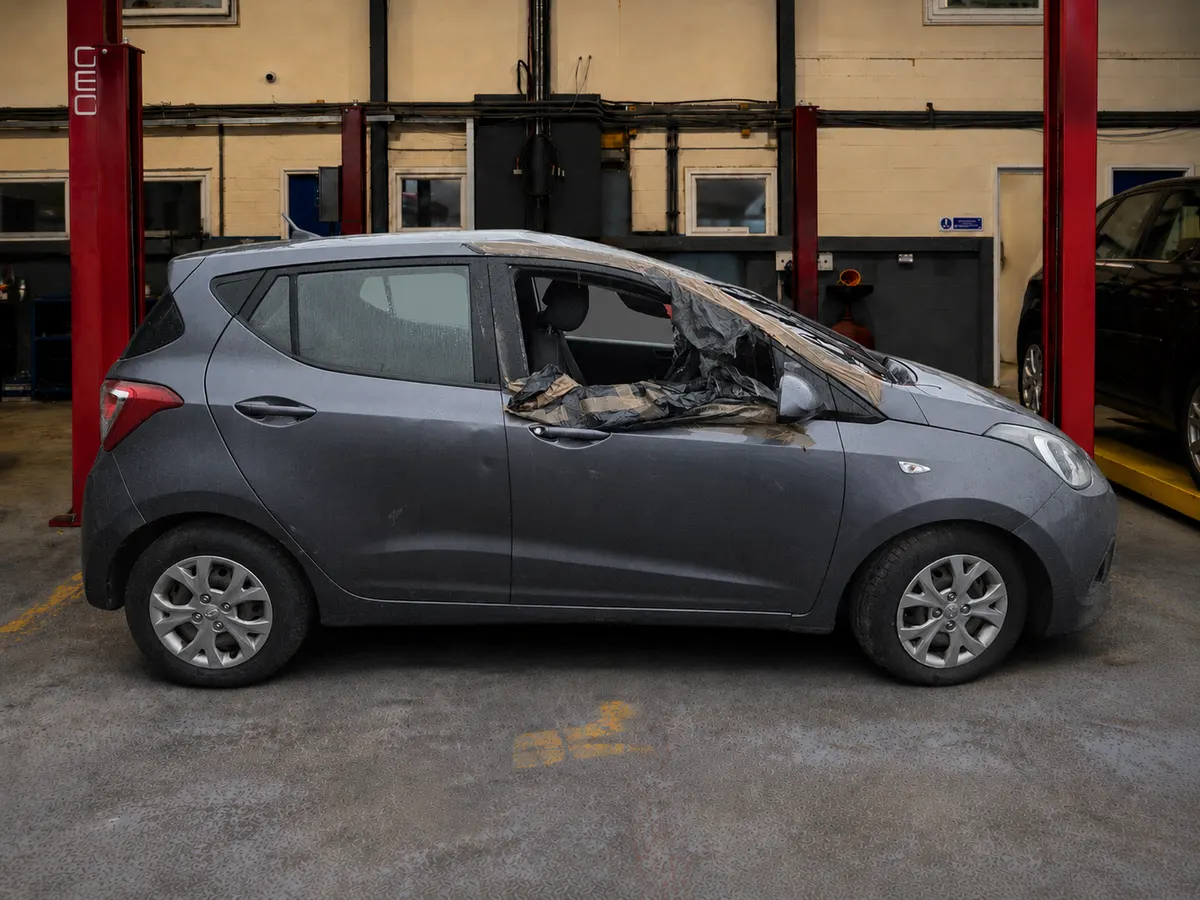

What “Cat B” actually means
Cat B stands for Category B. A Cat B vehicle is one your insurer has written off after damage so severe that the body shell can’t be repaired. The shell will be destroyed. Unlike Cat A, the undamaged parts on the vehicle (engine, gearbox, wheels, lights, interior, electronics) can be removed and resold by a registered breaker.
Cat B is one of the four current UK write-off categories under the ABI Code of Practice V12, published 28 May 2025. It sits between Cat A (whole vehicle destroyed) and Cat S (repairable structural damage; vehicle can return to the road).
The Cat B marker is permanent on the Vehicle Salvage & Theft Data register (VS&TD, formerly MIAFTR). The body shell never returns to UK roads. The parts continue to circulate through the second-hand market.
The official Cat B definition (ABI Code V12)
The ABI Code V12 defines Cat B as a vehicle whose body shell is too damaged to return to use, but where individual parts can be salvaged through legitimate channels.
The definition has two parts:
- The body shell is condemned. It gets destroyed at an Authorised Treatment Facility (ATF). It can’t be welded into another vehicle, sold as a project base, or used as the foundation for a rebuild.
- Parts can be salvaged. Components that haven’t been damaged in the accident come off and get sold into the second-hand parts market by a registered breaker. This is the single difference between Cat B and Cat A.
Cat B vs Cat A: the key distinction
Cat A and Cat B share one feature: neither allows the whole vehicle back on the road. Buy-back isn’t permitted on either, and both end with destruction at an ATF.
The difference is what happens to the parts.
Under Cat A, the whole vehicle (including every part on it) is condemned and crushed. The damage event compromises parts integrity as well as the shell: severe fire damage to wiring, water damage to electronics, structural impact damage propagated through nearby components.
Under Cat B, only the body shell is condemned. The undamaged parts can be removed by a registered breaker and resold. A typical Cat B vehicle might have a destroyed front structure but an intact engine, gearbox, rear suspension, doors, electronics, and wheels.
The AQP assessing the vehicle decides which side of the line it falls on. The test is whether parts integrity can be verified independently of the body shell damage.
Common Cat B causes
A car typically ends up Cat B through one of the following scenarios:
- Severe structural damage that ruins the shell. Heavy front, rear, or side impacts where the chassis cannot be repaired but the engine, gearbox, and other major components are far enough from the impact zone to remain intact.
- Damage that makes repair uneconomic at any cost but doesn’t compromise parts safety. The shell isn’t worth saving, but the parts come off the vehicle in usable condition.
- EV scenarios with localised body shell damage and an intact HV battery. Under V12, a Cat B EV is possible where the body shell is unrepairable but the HV battery and other components are safely recoverable.
The boundary with Cat A is set by parts safety. If the damage event (fire, flood, severe impact) propagates risk through the parts as well as the shell, the category becomes Cat A.
Cat B vs Cat A vs Cat S vs Cat N
| Category | Damage | Back on the road? | Parts salvageable? | V5C re-issued | Buy-back? |
|---|---|---|---|---|---|
| Cat A | Scrap, total destruction | No | No | No (destroyed) | No |
| Cat B | Shell unrepairable | No (whole vehicle) | Yes | No (destroyed) | No |
| Cat S | Repairable structural | Yes, after repair | n/a | Yes, with literal comment | Yes |
| Cat N | Repairable non-structural | Yes, after repair | n/a | Yes, no comment | Yes |
Source: ABI Code of Practice V12, May 2025; GOV.UK insurance write-offs guidance.
For the full pillar overview, see What is a car insurance write-off?.
What happens to a Cat B car
The sequence after categorisation is fixed.
The insurer takes possession at settlement. The vehicle then goes to a salvage auction, where a registered breaker buys it (or it’s directly assigned to a salvage partner under the insurer’s contracts). The breaker removes salvageable parts and sells them through the used-parts market. The body shell goes to an ATF for destruction; a Certificate of Destruction is issued. DVLA is notified, and the vehicle’s record is closed.
Buy-back isn’t permitted on Cat B. You can’t keep the car, even if you’d planned to break it for parts yourself. That’s the rule on Cat A and Cat B both: the body shell ends at the ATF, and ATFs are the only legal route. The Cat S and Cat N buy-back rights don’t extend to Cat B.
Once parts come off a Cat B donor, they enter the legitimate used-parts supply chain. They aren’t marked or tracked individually. A buyer of a used alternator has no way of knowing whether it came from a Cat B donor, a Cat S donor, an end-of-life scrappage vehicle, or a private dismantling.
What to do if your car is declared Cat B
The owner-side process is short and similar to Cat A.
Step 1: Accept or contest the settlement. The insurer offers you the pre-accident market value of the vehicle minus your excess and any outstanding finance. If you believe the offer is too low, you can challenge it with evidence (recent service records, comparable market listings, condition documentation) before the vehicle is transferred.
Step 2: Hand over the V5C. The original V5C (log book) is surrendered to the insurer. The vehicle leaves your possession permanently at this point. You can’t retain it for personal use or break it for parts yourself.
Step 3: Notify DVLA. You notify DVLA that your vehicle has been written off via gov.uk/written-off-vehicle. Failing to notify carries a £1,000 fine.
Step 4: Receive the settlement. The insurer pays the agreed amount. The salvage value (which is meaningful for Cat B because of the parts market) is built into the settlement calculation; you don’t receive an additional salvage payment on top.
The insurer then arranges sale at salvage auction and destruction of the shell. No further action sits with you.
Buying parts from a Cat B car
Cat B parts are legal to buy and sell. They circulate through the used-parts market alongside parts from end-of-life vehicles, voluntary scrappage, and Cat S/N salvage.
Buy from a registered breaker. Registered breakers are subject to environmental and trading regulations that unlicensed yards aren’t. They keep records of vehicle origin, handle hazardous components correctly, and sell legitimate parts. An unregistered yard’s parts have no traceable origin and may carry stolen-vehicle risk.
Safety-critical components warrant more caution. Airbags, brake components, ABS sensors, ADAS modules, seatbelt pretensioners, and structural fasteners all carry safety implications. A used airbag from a Cat B donor may not have been deployed, but its trigger circuitry might have been disturbed in the donor accident. Some manufacturers consider certain components non-reusable after any collision; the service manual is the reference point. For non-safety-critical parts (wheels, lights, interior trim, mechanical components from the unaffected end of the vehicle), the risk is much lower.
The donor’s Cat B status isn’t by itself a problem. Provided the breaker is registered and you treat safety-critical components with the same caution you’d apply to any used part, Cat B donor parts are a normal feature of the market.
FAQ
What does Cat B mean?
Cat B stands for Category B. It is a UK insurance write-off category for vehicles whose body shell is too damaged to return to the road, but whose parts can be salvaged by registered breakers. The shell is destroyed at an Authorised Treatment Facility; the parts continue to circulate through the second-hand parts market.
Can a Cat B car be driven?
No. A Cat B vehicle can't legally return to UK roads as a whole vehicle. The body shell must be destroyed.
Can a Cat B car be repaired?
No. Cat B is one of two non-repairable categories (the other is Cat A). The body shell cannot be repaired and the vehicle cannot be returned to the road as a whole.
Can I keep my Cat B car and break it for parts myself?
No. Owner buy-back is not permitted on Cat B. The vehicle is the insurer's property after settlement and is sold at salvage auction to a registered breaker, who handles the parts and arranges destruction of the shell.
What's the difference between Cat A and Cat B?
Cat A means the whole vehicle (including parts) is condemned and crushed. Cat B means only the body shell is condemned; parts can be salvaged and resold through registered breakers. Cat A involves damage that compromises parts safety (fire, flood, severe impact propagation). Cat B leaves parts safety intact.
Can I buy parts from a Cat B car?
Yes. Cat B parts are legal to buy and sell, and they circulate through the normal used-parts market alongside parts from other sources. Buy from a registered breaker, and treat safety-critical components (airbags, brakes, ABS, ADAS) with the same caution you would apply to any used part.
Are Cat B parts dangerous?
Not by virtue of being from a Cat B donor. The donor vehicle's Cat B status reflects body shell damage; the parts removed from non-damaged areas are typically intact. Safety-critical parts (airbags, brake components, seatbelt pretensioners) warrant case-by-case assessment because they may have been disturbed by the donor accident, but this caution applies to used parts generally and is not specific to Cat B donors.
Do I have to notify DVLA of a Cat B write-off?
Yes. You notify DVLA via gov.uk/written-off-vehicle. Failing to notify carries a £1,000 fine. The insurer's separate notification to VS&TD does not discharge your obligation.
Will I get salvage value for a Cat B car?
Not separately. The salvage value (which is meaningful for Cat B because of the parts market) is built into the settlement offer the insurer makes. You receive the pre-accident market value minus your excess and any outstanding finance.
Can a Cat B body shell be rebuilt or used for a project car?
No. The shell must be destroyed at an Authorised Treatment Facility, and a Certificate of Destruction is issued. There's no legal pathway for a Cat B shell back onto UK roads. Project rebuilds based on Cat B shells aren't permitted.
How long does the Cat B process take?
Typically two to four weeks from claim to settlement. The salvage auction and shell destruction happen after settlement and are arranged by the insurer.
Is the ABI Salvage Code law?
No. It's a voluntary industry code maintained by the Association of British Insurers. Around 97% of UK motor insurers (every ABI member) adhere to it. The government confirmed in February 2026 it has no plans to give the Code statutory footing.