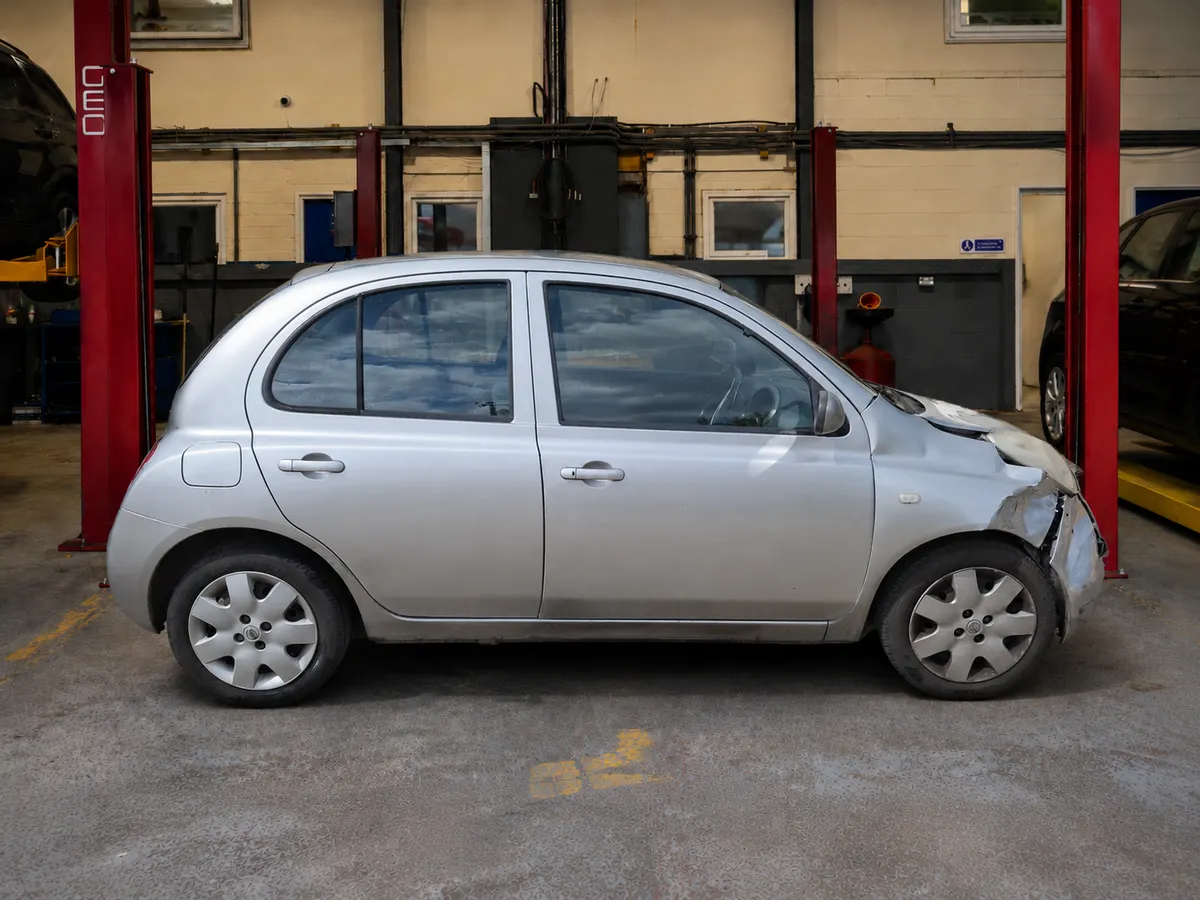



What “write-off” actually means
A car insurance write-off is what the industry calls a total loss. Your insurer has looked at the damage, looked at the cost of fixing it, and decided not to repair. They pay you what the car was worth before the accident and take ownership of the wreck. Unless you exercise your right to buy it back, that closes the relationship with the vehicle.
Every UK write-off gets a category. The category records the type of damage, and it determines what happens next.
- Cat A and Cat B: the car cannot legally return to the road.
- Cat S and Cat N: it can, once it’s been repaired properly.
The category stays with the vehicle permanently. It appears on every future history check and on the V5C log book, and there’s no mechanism to remove it. Repair quality, however good, doesn’t change the record.
It helps to understand the two flavours of write-off, because they answer different questions.
A Total Loss is a car that’s physically beyond repair. No qualified engineer is going to sign it off as roadworthy again. That’s Cat A or Cat B.
A Constructive Total Loss is a car that could be repaired, but the cost (parts, labour, paint, recalibrating modern safety systems) is more than the insurer wants to spend relative to what the car is worth. That’s Cat S or Cat N.
This is why the same accident on a five-year-old car and a fifteen-year-old car can produce very different outcomes. A newer car has more value and therefore more headroom before repair becomes uneconomic. An older car has less, which makes the write-off threshold easier to cross. The damage may be identical; the economics are not.
The rules are set by the Association of British Insurers in the ABI Code of Practice for the Categorisation of Motorised Vehicle Salvage. The current version is V12, published 28 May 2025.
Quick decision: which category is my car?
One question to start with: did the damage hit the structural frame or chassis?
- Yes, and it can be repaired → likely Cat S
- Yes, and it can’t be repaired → likely Cat B (body shell crushed, parts salvaged) or Cat A (everything destroyed)
- No, damage is bolt-on or cosmetic only → likely Cat N
- Car is unsalvageable in any form → Cat A
The Appropriately Qualified Person assessing your car makes the final call under the ABI Code V12.
Who decides, and how
Your insurer makes the call. But they don’t make it alone. They send out an Appropriately Qualified Person, or AQP. The AQP is a trained vehicle damage assessor with a current qualification, usually from the Institute of Automotive Engineer Assessors. They look at the damage, apply the rules in the ABI Code V12, and assign a category.
The decision is final. Unless you formally dispute it, that’s the category your car ends up with.
One rare edge case worth knowing about. If two insurers disagree on a category (usually when fault is contested), the settling insurer’s record takes precedence.
Something nobody tells you up front: the ABI Code isn’t statute. It’s a voluntary industry code. Around 97% of UK motor insurers, all the ABI members, adhere to it. Government has been asked to put it on a statutory footing several times. It has consistently declined, most recently in February 2026. Voluntary or not, 97% market coverage means it functions like industry law.
The four current write-off categories
These four apply to every write-off made by an ABI member since 1 October 2017. Each has its own deep-dive guide.
Cat A: Scrap/Recycle
The car is beyond any repair, and beyond salvage of parts. Even bits that look reusable, like the engine, seats, or doors, can’t be sold on. The structural framework containing the VIN has to be crushed. An Authorised Treatment Facility issues a Certificate of Destruction (V860), and the V5C is destroyed.
Typical causes: severe fire damage with chemical contamination, catastrophic crashes, flooding that’s compromised the electrical and biological safety of the vehicle. Can return to road: never. V5C re-issued: no.
Cat B: Break
Structural framework can’t be saved, so the body shell has to be crushed. The parts can be salvaged, though. Registered breakers strip out the engine, gearbox, glass, doors, trim. Anything not welded into the shell gets pulled and sold on.
Can return to road: never (the complete vehicle). V5C re-issued: no.
Cat S: Repairable Structural
The structural frame or chassis has been damaged, but the damage is repairable. Repair has to follow manufacturer-approved or Thatcham-recognised methods. A new MOT is typically required before the car returns to the road.
The Code defines “structural” via a specific list of 20 components. Chassis legs. B-post reinforcements. Inner sills. The firewall. And, new in V12, front and rear mega-castings (the single large aluminium components newer EVs are built around). Damage requiring repair, realignment, or replacement of any of these triggers Cat S. A scuff on the outer skin of a structural panel that doesn’t need realigning does not.
Can return to road: yes, once professionally repaired. V5C re-issued: yes, with a literal comment recording the status. The buyer applies for the new V5C using form V62 (free).
Cat S replaced the older Cat C category on 1 October 2017.
Cat N: Repairable Non-Structural
No damage to the structural frame or chassis. Damage is limited to bolt-on or cosmetic components: bumpers, bonnet, wings, doors, boot lid, roof panel, rear quarter. Safety-critical items like airbags or seat belts might still need replacement, but the underlying structure is intact.
Can return to road: yes, if repaired to a roadworthy condition. V5C re-issued: yes, no literal comment added. The existing MOT remains valid.
Cat N replaced the older Cat D category on 1 October 2017.
Category comparison table
| Category | Damage type | Back on the road? | V5C re-issued | Buy-back allowed? | Replaced |
|---|---|---|---|---|---|
| Cat A | Scrap, no usable parts | No | No (destroyed) | No | — |
| Cat B | Shell unrepairable, parts salvageable | No (whole vehicle) | No (destroyed) | No | — |
| Cat S | Repairable structural | Yes, after repair | Yes, with literal comment | Yes | Cat C (2017) |
| Cat N | Repairable non-structural | Yes, after repair | Yes, no comment | Yes | Cat D (2017) |
Source: GOV.UK insurance write-offs guidance; ABI Code of Practice V12, May 2025.
Legacy categories: Cat C and Cat D
Cat C and Cat D markers are still widespread. Millions of UK cars carry one. They’re not current categories. Both were retired on 1 October 2017. But the markers themselves stay valid forever on the cars they were applied to.
- Cat C was roughly equivalent to today’s Cat S. Repairable, but the repair cost was more than the car was worth. The older Code was cost-driven, not damage-driven.
- Cat D was roughly equivalent to today’s Cat N. Repairable, lighter damage, repair cost below market value, insurer wrote it off anyway.
A Cat C marker does not become a Cat S marker over time. A Cat D doesn’t become a Cat N. They stay as they were.
If you’re buying a car with one of these markers, the practical advice is the same as for the modern equivalent. Get a proper inspection. Ask for repair documentation. Expect a smaller insurance pool and a discount on the price.
Inline FAQ: Will my Cat C ever become a Cat S? No. The 2017 changeover applied only to new decisions from that date onwards. Existing markers stayed put.
What happens after the write-off decision
Once the AQP has confirmed the category, here’s the typical sequence:
- Settlement offer. Insurer calculates the pre-accident market value, deducts your excess and any outstanding finance, and offers you the net figure.
- You accept or dispute. Accept and you sign over ownership. Dispute and you begin the negotiation process.
- V5C goes to your insurer. You keep the yellow “sell, transfer or part-exchange to the motor trade” section.
- You tell DVLA. Via gov.uk/written-off-vehicle. This is your responsibility as the registered keeper, not your insurer’s. Failing to notify carries a £1,000 fine. It’s a routinely missed step, and the fine is enforced.
- VS&TD record is created. Your insurer enters the vehicle on the Vehicle Salvage & Theft Data register within two working days of the final categorisation. This used to be called MIAFTR. It migrated to MIB Navigate and was renamed VS&TD on 24 November 2025. Same database, same function, new name. The record is permanent.
- Car is collected. Cat A and B go to an Authorised Treatment Facility. Cat S and N go either to salvage auction or stay with you, if you’ve bought it back.
After you’ve notified DVLA, you’ll get an automatic refund of any unused full months of vehicle tax. Any tax Direct Debit you had set up is cancelled.
How the payout is calculated
The formula:
Pre-accident market value minus policy excess minus outstanding finance minus any deductions for wear or personal items = your net payment.
Pre-accident market value
What your car was worth the day before the accident. The insurer’s assessor uses industry valuation tools (Glass’s Guide, CAP Black Book) plus live market data to land on the figure. The opening offer typically sits at the lower end of the market range.
You’re not obliged to accept it. See Your rights below.
Excess
The amount you agreed to pay toward any claim when you took the policy out. Two components:
- Compulsory excess set by the insurer (often £250 to £350)
- Voluntary excess you opted into for a cheaper premium (£100 to £1,000)
Both come out of the payout.
Outstanding finance
If the car is on PCP, HP, or any other finance arrangement, the insurer pays the finance company directly to clear the balance. Anything left over goes to you. If the market value doesn’t clear the finance, you can be out of pocket. That’s where GAP cover earns its keep.
GAP insurance
Guaranteed Asset Protection covers the gap between the market value your insurer offers and either your original purchase price or your outstanding finance balance. It matters most on newer cars on finance, where market value can fall faster than the loan balance.
Your rights: disputing valuation and buying back
Disputing the valuation
The insurer’s pre-accident market value is an assessment, not a settled fact. You’re entitled to challenge it. The opening offer typically sits at the lower end of the market range, so it’s worth doing the work to test whether that figure is fair.
To dispute it effectively, you need evidence:
- Live listings on Auto Trader or similar for the same make, model, mileage, age, trim
- Dealer valuations for an equivalent vehicle
- Consumer valuation tools (Glass’s Guide, Parkers)
- Recent sold prices if you can find them
The closer the match, the more weight it carries. Same year, same trim, similar mileage, similar condition. A general statement from a dealer rarely shifts the number on its own. You need specifics.
If you’ve worked through the insurer’s internal complaints process and they’re still not moving, you can refer the dispute to the Financial Ombudsman Service. It’s free. The Ombudsman has consistently held that valuations should reflect the actual retail market, not the trade buy-in price.
Retaining the vehicle (buy-back)
For Cat S and Cat N, you have the right to buy your own car back from the insurer. You take a reduced payout (because you’re keeping the salvage), and the vehicle stays with you. Repair it, sell it, break it for parts. Your choice.
Cat N buy-back:
- Insurer pays out and sells the vehicle back to you
- You keep your original V5C, no replacement needed
- DVLA records the Cat N marker against the vehicle
Cat S buy-back:
- Insurer pays out and sells the vehicle back to you
- You send the complete V5C to your insurer
- You apply for a free duplicate via form V62
- The new V5C records the Cat S marker
Cat A and Cat B: buy-back is not permitted — Cat A vehicles have to be destroyed in full, Cat B body shells have to be crushed.
If you’ve got a personalised registration number on a written-off vehicle and want to keep it, you have to apply to retain it before the vehicle is destroyed. Leave it any later and the number is cancelled permanently. Plates are routinely lost this way.
What the VS&TD record means for you
Once your insurer enters the write-off on VS&TD (Vehicle Salvage & Theft Data, the database formerly known as MIAFTR), the category is a permanent part of the vehicle’s history. It cannot be deleted. Only corrected, and only for clerical errors. DVLA receives a nightly data feed from the Motor Insurers’ Bureau.
For a future buyer running a vehicle history check (HPI Check, Experian AutoCheck, or any reseller using their data), the Cat A/B/S/N marker will show up. This affects three things:
- Resale value. Industry estimates suggest Cat N typically sells for around 20-40% less than a clean-title equivalent, and Cat S for around 30-50% less. Actual discount varies widely by make, model, repair quality, and documentation.
- Insurance. Cat N attracts a premium uplift of roughly 20-50% over a clean equivalent, and Cat S 30-80%. Some mainstream insurers decline Cat S entirely. You may need to approach a specialist.
- Disclosure. When you take out an insurance policy on a written-off car, the insurer will ask about its history at quote stage. Answer honestly. Failure to disclose when asked is misrepresentation under the Consumer Insurance (Disclosure and Representations) Act 2012 and can void your cover. The duty bites when you’re asked, not before. You’re not required to volunteer the information unprompted.
A small number of write-offs never make it onto VS&TD. Third-party-only claims with no payout. Self-insured fleet vehicles (police, councils). Historical paper-notification cases. It’s one of the reasons a vehicle history check is necessary but not sufficient on its own. An independent pre-purchase inspection catches what the database misses.
FAQ
Is a write-off the same as scrapping the car?
No. Scrapping is a destruction process at an Authorised Treatment Facility. A write-off is an insurance decision. Cat A and Cat B write-offs end in scrapping; Cat S and Cat N write-offs don't. Those cars can return to the road after repair.
Who decides the write-off category?
An Appropriately Qualified Person (AQP). They're a trained, currently-qualified vehicle damage assessor working on behalf of your insurer. The AQP applies the ABI Code V12 rules to your specific damage and assigns the category. The decision is final unless formally disputed.
Can I refuse to let my insurer write the car off?
You can dispute the write-off decision or the valuation, but you can't prevent the categorisation if the AQP determines it under the Code. What you can do is buy the vehicle back (Cat S or Cat N only) and keep it, repair it, or sell it on yourself.
Will a Cat S or Cat N marker ever come off the V5C?
No. Once recorded on VS&TD and against the DVLA record, the marker is permanent. It can't be removed by repair, by passing an MOT, or by time elapsing.
Do I have to tell DVLA myself, or does the insurer do it?
You do. Your insurer enters the vehicle on VS&TD, but the legal duty to notify DVLA falls on you as the registered keeper. The fine for failure is £1,000. The online service at gov.uk/written-off-vehicle needs only the 11-digit reference from the yellow section of your V5C.
What's the difference between Cat S and Cat C? Cat N and Cat D?
Cat S replaced Cat C and Cat N replaced Cat D on 1 October 2017. The old categories were based on repair cost relative to the vehicle's value. The new categories are based on the type of damage (structural vs non-structural). A Cat C or Cat D marker on an older vehicle stays in place forever and doesn't convert to the new system.
Can I drive a Cat S or Cat N car straight away?
A Cat N car can be driven once it's been repaired to a roadworthy condition, and its existing MOT remains valid. A Cat S car typically needs a new MOT after structural repair, and many insurers require an engineer's report before they'll quote on it.
How long does the write-off process take?
Typically two to four weeks from claim submission to settlement. The first week covers inspection and AQP assessment. The second covers valuation and the settlement offer. The third covers acceptance, V5C handover, and payout. Disputes can extend this significantly.
What is MIAFTR, and why is it now called VS&TD?
MIAFTR was the Motor Insurance Anti-Fraud and Theft Register, the industry database recording write-offs and stolen vehicles. On 24 November 2025 it migrated to the Motor Insurers' Bureau's MIB Navigate platform and was renamed Vehicle Salvage & Theft Data (VS&TD). The function is identical. Only the name and the underlying system changed.
Can I get a Cat S or Cat N marker removed if the repair is excellent?
No. The marker reflects the history of the vehicle, not its current condition. A well-repaired Cat S car is still a Cat S car. Good repair documentation does help in other ways: better resale value, more buyer confidence, and a smaller discount when you sell.
What if my car was written off but I never made a claim. Does it still get a marker?
If no claim was made and no payout issued, the vehicle isn't entered on VS&TD by the insurer, and there's no Cat marker. This is one of the well-documented gaps in the system. Third-party-only insured vehicles, self-insured fleet vehicles, and some paper-notified cases never appear on history checks. It's one reason a physical inspection still matters when buying used.
Is the ABI Salvage Code law?
No. It's a voluntary industry code, not statute. The Association of British Insurers maintains it with input from Thatcham Research, the Motor Insurers' Bureau, DVLA, and others. Around 97% of UK motor insurers, every ABI member, adhere to it. The government confirmed in February 2026 that it has no plans to give the Code statutory footing.