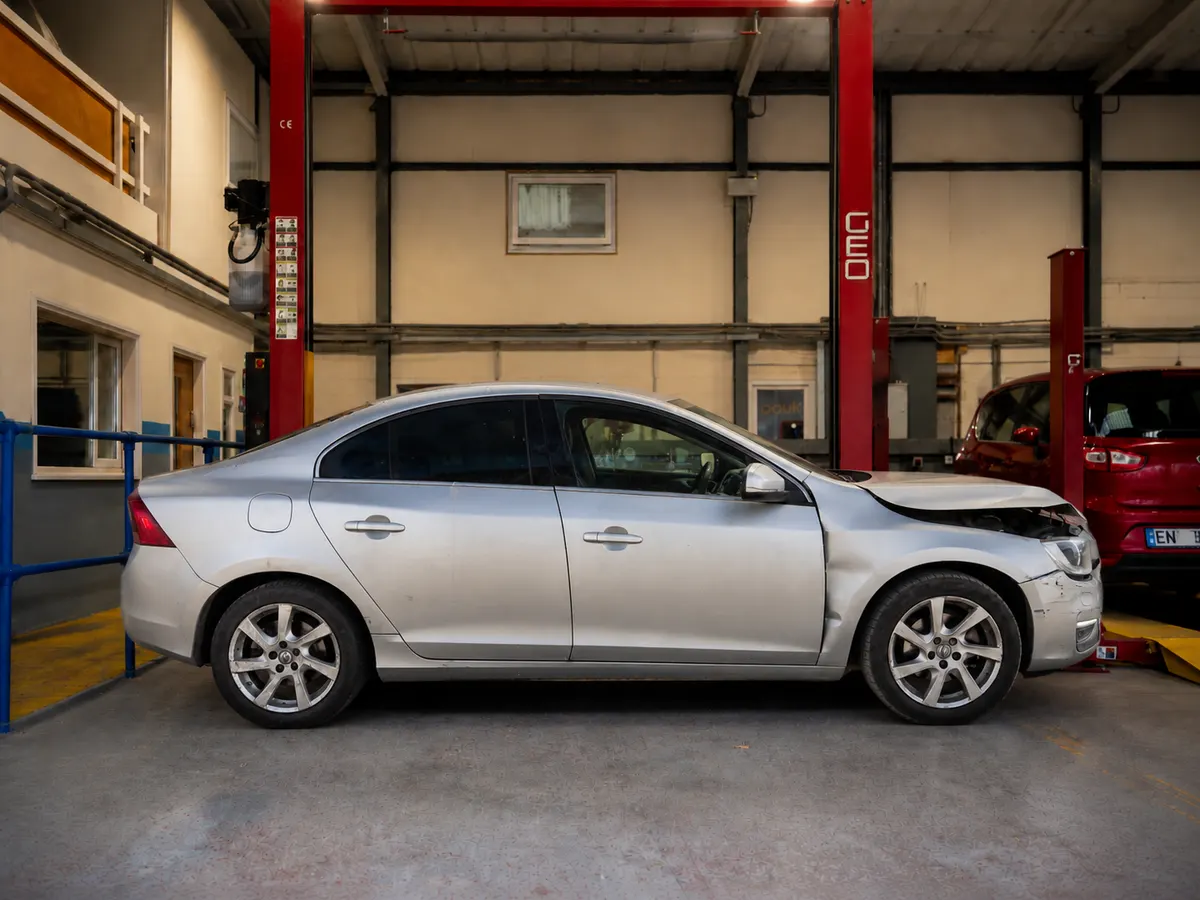



Why EVs need their own write-off rulebook
For most of the salvage industry’s history, a write-off was a write-off. The damage was assessed, the repair cost was compared to the car’s value, and the vehicle was categorised. The fuel type was irrelevant.
Electric vehicles broke that model.
Two things make EVs different from a salvage perspective. The first is the high-voltage battery, which now accounts for up to 40-55% of an EV’s value according to Thatcham and ABI data. A modest collision that would be a straightforward repair on a petrol car can write off an EV simply because the battery pack is suspect. The second is construction. Tesla’s single-piece mega-castings, now adopted by other manufacturers, mean that what used to be a multi-panel repair is now a single structural casting that often has to be replaced wholesale.
The 2025 update to the ABI Code of Practice (Version 12, published 28 May 2025) is the first version of the Code with explicit EV rules. If you’re researching an electric write-off, V12 is the document you need to understand. Everything older (V11 from 2019, the various pre-2017 frameworks) predates the EV-specific rulebook entirely.
What V12 changed in May 2025
V12 introduced three changes that matter for EV buyers.
First, the Cat S structural component list grew. Items 10 and 11 are now the front and rear 1-piece mega/giga castings. If either is damaged on an EV (or any car built that way), the vehicle is Cat S by definition. That’s the same structural bar that applies to chassis legs and pillar reinforcements.
Second, Section 8 of V12 sets out EV and hybrid categorisation rules for the first time. The central concept is whether the high-voltage battery is structural or non-structural. We cover that in the next section, because everything else flows from it.
Third, V12 tightens the requirements around HV battery handling. All HV vehicles, and any removed batteries, must be stored in a controlled environment with safety labelling. Some manufacturers deem their batteries non-repairable, which means recycling rather than refurbishment. Any repair to an HV battery requires a qualified HV technician.
Thatcham Research followed up in March 2026 with the EV Blueprint, a set of eight recommendations aimed at reducing unnecessary EV write-offs. The Blueprint is industry guidance rather than regulation, but it shapes how insurers approach borderline EV claims and is worth knowing exists when you’re negotiating either a claim or a purchase.
How EVs get categorised: A, B, S, N for electric cars
The four categories still exist for EVs, but V12 adds EV-specific triggers.
Cat A (EV): The vehicle must be destroyed. If the HV battery can be safely removed, it must be removed and recycled separately. If the battery can’t be safely separated (severe fire damage, for example), the battery is recycled as part of the complete vehicle. Cat A EVs never return to the road and no parts can be salvaged.
Cat B (EV): The body shell must be destroyed but functional parts can be reused. The HV battery is assessed individually for recycling or reuse, with reuse only permitted if the battery can be warranted by a qualified party.
Cat S (EV): The vehicle has structural damage and is repairable. For an EV, the structural test now explicitly includes the HV battery. If a structural HV battery is damaged, the vehicle must be classed as Cat S. The mega-casting items added at numbers 10 and 11 of the structural list apply identically here.
Cat N (EV): The vehicle has non-structural damage and is repairable. For an EV, this category only applies if any damaged HV battery is non-structural. The battery may have been compromised, but the damage is classed as non-structural rather than structural.
Note that water ingress in the passenger compartment carries a specific warning in V12 for EVs and hybrids. If electrical or safety components are compromised by flooding, the vehicle needs special consideration before any category decision is made.
Structural vs non-structural HV battery: the central distinction
V12’s Illustration 1 sets out the difference visually, and it’s the key concept for an EV buyer to understand.
A structural HV battery forms part of the vehicle’s chassis structure. There are two patterns. In one, the body has no floor panel and the battery itself acts as the floor and structural crossmembers, with the seats fixed directly to the battery. In the other, the body has a flat floor panel but no underside crossmembers, so removing the battery impacts the floor structure. Both are structural. Tesla’s modern platforms, particularly the Model Y, use this construction. So do an increasing number of other manufacturer platforms aimed at the EV-native market.
A non-structural HV battery sits in a body that has its own structural crossmembers independent of the battery. The battery can be removed and the body retains its structural integrity. This is the layout on many converted or transitional EV platforms, where an existing combustion-car body was adapted to take an electric drivetrain.
The practical effect is this: damage to the battery on a structurally-batteried car is, by default, Cat S. The same damage on a non-structurally-batteried car can be Cat N. Two cars from different manufacturers with identical visible damage can end up in different categories purely because of how the battery is mounted.
If you’re shopping for an EV write-off, whether the car has a structural or non-structural battery is a question for the manufacturer’s own documentation, not the seller’s assumption. Get it in writing. Sellers occasionally guess at this, and their guess isn’t a substitute for the technical reference.
Mega-castings: the Tesla problem
Tesla pioneered single-piece mega-castings, sometimes called giga-castings. The principle is to replace dozens of welded panels in the front or rear underbody with a single aluminium casting. It saves weight, reduces assembly time, and improves crash performance up to a point. The Tesla Model Y was the first volume car built this way.
The problem for write-off economics is that a single-piece casting is, by definition, a single repair item. Thatcham Research’s 2025 testing on the Model Y found that at low severity (around 15 km/h), the mega-casting takes no structural damage. At medium severity (around 25 km/h), the full mega-cast typically needs to be replaced because cracks propagate through the casting in ways that can’t be locally repaired.
Other manufacturers are adopting the technique. Mega-castings are no longer a Tesla-only consideration. V12 adds them to the structural list precisely because the Code now needs to address a structure type that didn’t exist when V11 was written.
For a buyer, the implication is direct. If you’re looking at an EV write-off where the original damage was at the front or rear underbody, ask which component was replaced. If a mega-cast was replaced, the repair quality and the engineering sign-off matter more, not less, than a traditional panel-and-weld repair, because there’s no way to verify the new casting is fitted correctly without a competent inspection.
Why EVs get written off more often
EV claims are approximately 25% more expensive than petrol or diesel equivalents, and EV repairs take approximately 14% longer (Thatcham, ABI). Three factors drive this.
The battery is the dominant one. At 40-55% of vehicle value, even moderate damage that requires battery replacement pushes the repair cost over the write-off threshold quickly. Only around 2% of EV repairs currently involve battery refurbishment rather than replacement, because the supply chain, the skills, and the manufacturer warranty positions all point toward swap rather than fix.
The second factor is sensor density. EVs tend to carry more ADAS sensors and cameras than equivalent petrol cars, and structural repairs require recalibration of those systems before the car can return safely to the road. Recalibration adds cost and time.
The third is shop availability. The number of UK body shops qualified to work on HV systems is smaller than the number qualified to work on petrol cars. That has knock-on effects on labour rates, lead times, and the willingness of insurers to authorise an in-network repair versus a write-off.
Thatcham’s March 2026 EV Blueprint exists specifically because the industry recognises that some EV write-offs are unnecessary. The Blueprint is worth a look if you want to understand the direction of travel. For now, though, the rate of EV write-offs per claim remains higher than for combustion vehicles, and that fact shapes the pricing of EVs at salvage auction.
ADAS and EVs
ADAS (Advanced Driver Assistance Systems) covers lane keep, adaptive cruise, automatic emergency braking, blind spot monitoring, and the camera and radar arrays that feed them. After any structural repair, these systems require recalibration. Failure to recalibrate leaves the safety systems impaired in ways that aren’t always obvious from the driver’s seat.
On a Cat S EV, ADAS recalibration is mandatory. On a Cat N EV, it’s still recommended whenever a sensor mounting point has been disturbed, even if the disturbance was cosmetic. When you’re inspecting a Cat S or Cat N EV, ADAS calibration paperwork is one of the documents to ask for. If the body shop can’t show it, that’s a flag.
Should you buy an EV write-off? The decision framework
The general principles for buying a Cat S or Cat N car apply equally to EVs, but EVs introduce two extra questions that don’t exist for petrol cars.
Question one: is the battery confirmed clean? Not “the seller says so” and not “the original damage was nowhere near the battery.” Confirmed clean means an HV battery state-of-health report from a qualified HV technician, ideally on manufacturer diagnostic equipment, dated after the repair.
Question two: is the manufacturer warranty intact? Most EV manufacturers offer separate warranties on the battery (typically 8 years or 100,000 miles, with a state-of-health threshold). A write-off doesn’t automatically void the battery warranty, but the repair pathway and the parts used can. If the warranty has been voided, you’re absorbing battery risk that a clean-title buyer wouldn’t carry. That changes the discount maths.
Those two questions sit on top of the standard buy-decision framework: history check, V5C verification, documentation pack, body shop credibility, pre-purchase inspection, insurance confirmation, finance acceptance, and an exit-resale plan.
The financial maths for EV write-offs
EV write-offs trade at a deeper discount to clean-title equivalents than petrol or diesel write-offs, for two reasons. The pool of willing buyers is smaller (EV buyers are still a minority of the UK market overall), and the technical complexity of verifying the repair is higher.
Industry estimates suggest a Cat S EV typically trades at 35-55% below the clean-title book value, and a Cat N EV at 25-45% below, depending on age, make, mileage, and the specific damage profile. Insurance uplift on an EV write-off is wider than on combustion equivalents, with industry estimates suggesting 40-90% above the clean-title premium for Cat S EVs and 25-60% for Cat N EVs.
Worked example. A three-year-old Tesla Model Y with a clean-title book value of £30,000 and a Cat S marker. A 40% discount puts the asking price at £18,000. Annual insurance moves from £1,400 (clean-title) to £2,400 (Cat S, mid-range uplift). Over five years that’s an extra £5,000 of insurance. Resale at year five at a 35% discount versus clean-title means you exit at £15,600 against a clean-title £24,000, a £8,400 resale shortfall. Total cost of ownership penalty: £13,400. Total saving on entry: £12,000. The maths is marginal even at a 40% discount, which is why the genuine sweet spot for EV write-offs is closer to 45-50%, not the 30% that works for combustion Cat S.
Run the numbers on the specific car. Don’t accept the seller’s headline discount as gospel.
Documentation pack: what’s non-negotiable on an EV
The standard Cat S or Cat N documentation pack applies (re-issued or original V5C, engineer’s report, repair invoices, body shop letter, history check). For an EV, add three items.
- HV battery state-of-health report from a qualified HV technician, dated after the repair. Ideally on manufacturer diagnostic equipment.
- ADAS calibration paperwork for every sensor mounting point disturbed during the repair. Look for the equipment used and the technician credentials.
- Manufacturer warranty position letter confirming whether the battery warranty (and any other powertrain warranties) remains in force given the repair pathway.
Missing any of the three on a Cat S EV is a negotiation point at minimum, and a walk-away if the asking price was already at the top of the typical Cat S range.
Red flags specific to EVs
Beyond the standard write-off red flags, three things should give you pause on an EV.
A seller who can’t name the body shop that handled the HV work. HV repairs aren’t a generic body-shop service. The named shop should be one of the manufacturer-approved or HV-certified network. If the seller doesn’t know, walk.
A manufacturer diagnostic that shows battery cell imbalance beyond manufacturer tolerances. Cell imbalance is an early warning of pack damage that may not yet show up as a state-of-health number. Any reading flagged as out-of-tolerance is a walk-away unless the seller commissions a follow-up pack-level inspection.
A mega-cast replacement done outside the manufacturer-approved network. Independent body shops can repair traditional steel structures competently. Mega-cast replacement is a different proposition because of the bonding, the calibration, and the assembly precision required. If the work was done outside the approved network on a mega-cast car, you’re absorbing structural risk that the next buyer will discount harder than you did.
How to inspect an EV write-off
The general 6-step inspection from Should I buy a Cat S car? applies, with three EV-specific additions.
- Run the history check first. HPI Check or Experian AutoCheck. Confirm the Cat S or Cat N marker on the VS&TD register.
- Inspect the V5C and verify the VIN. Cat S EVs have a re-issued V5C with the Cat S literal comment. Cat N EVs keep the original.
- Read the engineer’s report and the repair invoices end to end. For Cat S, confirm which structural item was repaired. Ask specifically whether a mega-cast was replaced.
- Get the HV battery state-of-health report. Independent or manufacturer-diagnostic. Anything below 90% state-of-health on a recent EV is a major negotiation point.
- Get ADAS calibration paperwork. One sheet per sensor mounting point that was touched.
- Commission an EV-specialist pre-purchase inspection. £400-£700 typically. That’s more than the standard Cat S inspection because EV diagnostics needs specialist equipment. A qualified HV-certified inspector is the single highest-value safeguard.
Insurance for EV write-offs
The standard insurance protocol applies, but the EV-specific complication is that the panel of insurers willing to quote on an EV write-off is narrower than the panel for a petrol equivalent. Some specialist EV insurers won’t quote at all on a Cat S EV. Others quote at a meaningful uplift but accept the risk.
Before you commit, get a written quote on the specific VIN from at least three insurers. Confirm the quote covers Cat S or Cat N, and check the policy excess on battery-related claims specifically. Some insurers attach a separate, higher excess to battery damage, which is the kind of detail that doesn’t show up in a price comparison and matters a lot if you ever need to claim.
A declined quote from a specialist EV insurer on a specific VIN, in writing, is meaningful leverage to negotiate the asking price down further.
Resale: the EV-specific exit discount
The Cat S or Cat N marker is permanent, and EV write-offs carry an additional resale discount on top of the standard write-off discount. The reason is buyer psychology: a future buyer is being asked to absorb both the write-off marker and the perceived battery risk, and the two stack rather than offset.
Industry estimates suggest a Cat S EV held for five years exits at 30-40% below clean-title book value, and a Cat N EV at 20-30% below. That’s wider than the equivalent combustion gap. Price the exit discount in before you sign anything.
The corollary is that EV write-offs work much better as long-hold purchases than as short-term flips. If you intend to keep the car for five-plus years, the maths can land well. If you intend to flip it in twelve months, the exit discount eats the entry saving.
FAQ
Are EVs more likely to be written off than petrol cars?
Yes. EV claims are approximately 25% more expensive than petrol or diesel equivalents and EV repairs take approximately 14% longer (Thatcham, ABI data). The high-voltage battery, which accounts for up to 40-55% of an EV's value, is the dominant cost driver. Even moderate collision damage near the battery pack frequently pushes the repair cost above the write-off threshold.
What is V12 and why does it matter for EVs?
V12 is the May 2025 version of the ABI Code of Practice for the Categorisation of Motorised Vehicle Salvage. It's the first version of the Code with explicit EV rules. Section 8 of V12 sets out how Cat A, B, S, and N apply to electric and hybrid vehicles, and items 10 and 11 of the Cat S structural list now cover front and rear 1-piece mega/giga castings.
What's the difference between a structural and non-structural HV battery?
A structural HV battery forms part of the vehicle's chassis. The battery acts as the floor and structural crossmembers, with the seats fixed directly to the battery. A non-structural HV battery sits in a body that has its own structural crossmembers and can be removed without affecting structural integrity. The distinction determines whether battery damage results in Cat S or Cat N.
Is a Tesla with a mega-cast repair a Cat S?
If a mega/giga casting was damaged and repaired or replaced, yes. V12 lists the front and rear 1-piece mega/giga castings as structural items, which makes any damage requiring repair or replacement a Cat S trigger. A Tesla with a mega-cast replacement should carry a re-issued V5C with the Cat S literal comment.
How much discount should I expect on a Cat S EV?
Industry estimates suggest 35-55% below clean-title book value, depending on age, make, mileage, and damage profile. That's a wider discount than the 30-50% typical for petrol or diesel Cat S, because the EV buyer pool is smaller and the inspection complexity is higher.
Can I get insurance on an EV write-off?
Yes, but the panel of willing insurers is narrower than for combustion equivalents. Get written quotes on the specific VIN from at least three insurers before you commit. Confirm the quote covers Cat S or Cat N and check whether there's a separate excess on battery-related claims.
Does a Cat S marker void the battery warranty?
Not automatically. The battery warranty position depends on the repair pathway, the parts used, and the manufacturer's specific terms. Ask the seller for a written warranty position letter from the manufacturer before purchase. If the warranty has been voided, you're absorbing battery risk that materially changes the value of the car.
What is the Thatcham EV Blueprint?
The Thatcham EV Blueprint is a set of eight industry recommendations published in March 2026, aimed at reducing unnecessary EV write-offs. It's industry guidance rather than regulation, but it shapes how insurers approach borderline EV claims and points to the direction of repair-versus-write-off industry policy.
What HV battery state-of-health is acceptable on a used EV?
On a recent EV (under three years old), look for state-of-health above 90%. Between 85-90% is normal for cars three-to-five years old. Anything below 85% on a recent EV is a major negotiation point. Anything below 80% on a write-off where the battery was anywhere near the original damage warrants a fresh pack-level inspection.
Why are mega-castings a problem for repair?
Mega-castings are single-piece aluminium structures that replace dozens of traditional welded panels. When damaged beyond cosmetic level, they typically require full replacement rather than localised repair. Thatcham's 2025 testing on Tesla Model Y found no structural damage at 15 km/h impacts but full mega-cast replacement required at 25 km/h due to crack propagation through the casting.
Should I buy an EV write-off as a first EV?
Usually not. A first EV purchase involves enough new variables (charging, range, software updates, warranty terms) without adding the layered risk of a write-off. If you're committed to an EV write-off as a first EV, partner with an HV-certified inspector and budget more time on documentation than you would for a combustion equivalent.
Where can I check whether an EV is a write-off?
Run an HPI Check or Experian AutoCheck on the VIN. Both providers have direct access to the Vehicle Salvage & Theft Data register (VS&TD, formerly MIAFTR, migrated 24 November 2025). The check will return the category marker (A, B, S, or N) if one is recorded, alongside theft and finance markers.